


Artificial intelligence is transforming how people search online. While SEO remains essential, businesses now also need AEO (Answer Engine Optimization) and GEO (Generative Engine Optimization) to appear in AI-powered platforms like ChatGPT, Gemini, Perplexity, Claude, and Google AI Overviews. Companies that combine all three strategies will be better positioned to earn trust, increase visibility, and attract customers in the AI era.

SEO alone is no longer enough—businesses now need SEO, AEO, and GEO to stay visible across search engines and AI platforms.
For more than two decades, businesses have focused on one primary goal: ranking on Google.
If your website appeared on the first page of search results, chances were good that potential customers would eventually find you. That strategy still matters today—but the rules of online search have changed dramatically.
Millions of people no longer begin every search on Google. Instead, they ask questions directly to ChatGPT, Gemini, Claude, Perplexity, Microsoft Copilot, and other AI-powered assistants. Rather than displaying a list of websites, these platforms generate complete answers, often recommending businesses, quoting websites, and citing trusted sources without requiring users to click through multiple search results.
For business owners and professionals, this represents one of the biggest shifts in digital marketing since Google itself transformed the internet. The good news? You don’t need to abandon SEO. You simply need to understand that modern online visibility now depends on three complementary strategies: SEO, AEO, and GEO.
SEO: The Foundation Still Matters
Search Engine Optimization (SEO) remains the cornerstone of digital visibility. Google, Bing, and other search engines continue to reward websites that offer valuable content, fast loading speeds, mobile-friendly design, strong technical performance, and clear site architecture. T
Traditional SEO also includes optimizing keywords, earning quality backlinks, improving local search visibility, and publishing helpful content that answers users’ questions. Simply put, SEO helps search engines understand what your website is about and why it deserves to rank. But today, ranking on Google is only part of the equation.
AEO: Optimizing for Direct Answers
Answer Engine Optimization (AEO) focuses on helping search engines and voice assistants provide immediate answers to users. Instead of competing only for traditional rankings, businesses now compete for Featured Snippets, “People Also Ask” sections, voice search results, and AI-generated summaries.
AEO rewards websites that organize information clearly. Simple headings, concise explanations, FAQ sections, structured data, and well-organized content make it easier for search engines – and AI systems – to understand your expertise and present your information directly to users. When someone asks, “What is the best CRM for small businesses?” or “How often should I service my HVAC system?”, answer engines are looking for content that is clear, trustworthy, and easy to extract.
GEO: Becoming Visible to Artificial Intelligence
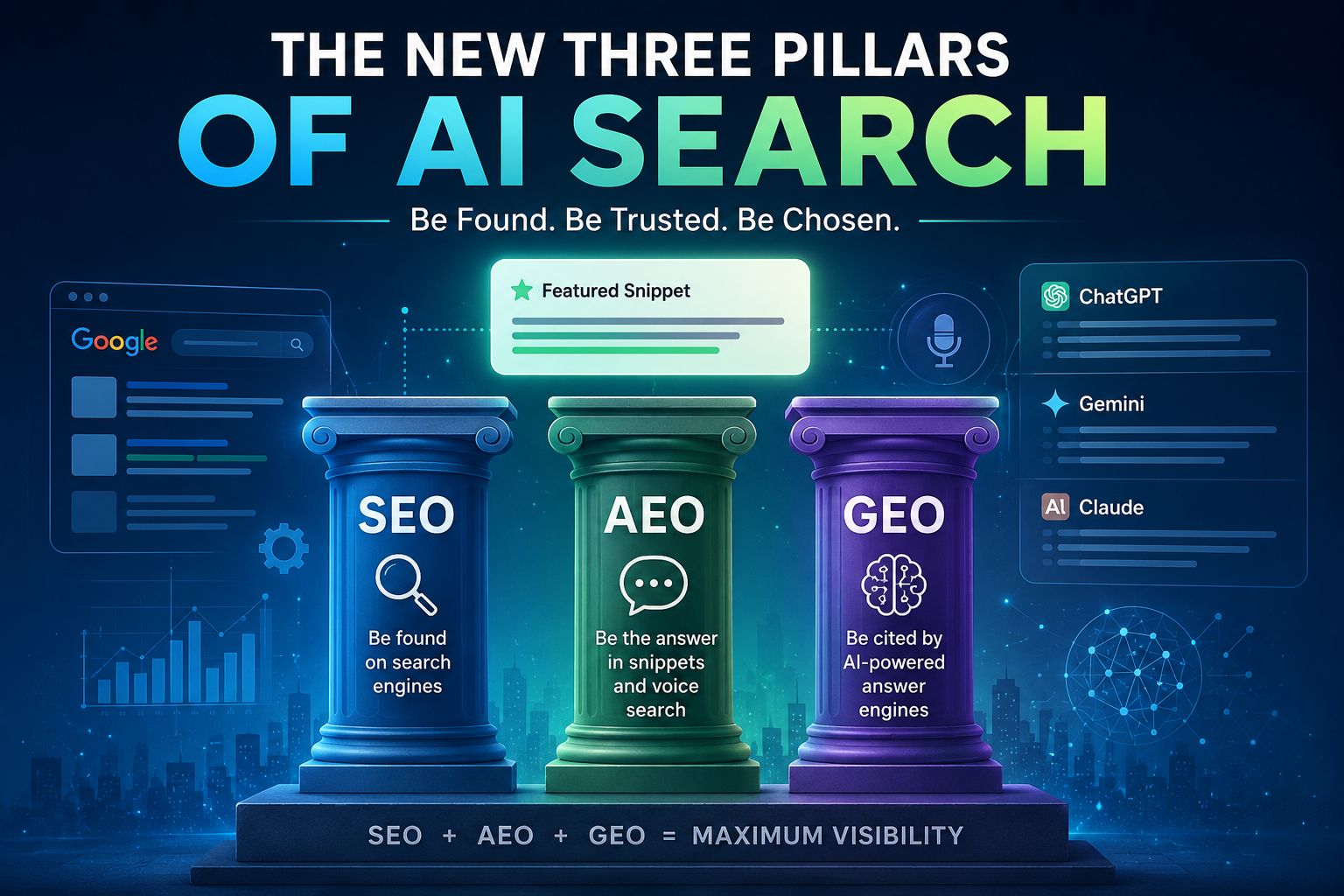
Well-structured, trustworthy, and expert-driven content has the greatest chance of being cited by AI-generated responses
Generative Engine Optimization (GEO) is the newest piece of the puzzle. Unlike traditional search engines, generative AI platforms don’t simply rank websites. They analyze information from multiple trusted sources before generating a response. Their goal is to recommend the most reliable, authoritative, and relevant information available.
This means businesses must think beyond keywords. AI systems are increasingly evaluating expertise, topical authority, semantic relationships, structured information, brand consistency, and the overall trustworthiness of a website. Content that genuinely educates readers, answers real questions, and demonstrates subject-matter expertise has a much greater chance of being referenced by AI-generated responses.The objective is no longer just earning clicks.It’s becoming a trusted source that AI systems are confident enough to cite.
The Future Belongs to Businesses that Build Trust
Many small business owners worry that artificial intelligence will replace websites. The reality is quite different. AI is changing how people discover businesses – not whether they need businesses. Customers still need lawyers, accountants, restaurants, physicians, contractors, consultants, financial advisors, and local service providers. What has changed is the path they take before making a decision.
Today’s buyers expect immediate, accurate answers before they ever contact a company. Businesses that consistently publish helpful, well-structured, and trustworthy content are far more likely to appear wherever customers search – whether that’s Google Search, Google’s Featured Snippets, voice assistants, ChatGPT, Gemini, Claude, or Perplexity.
Final Thoughts
The future of digital visibility isn’t about choosing between SEO, AEO, or GEO. It’s about combining all three.Think of SEO as the foundation that helps search engines find your website. AEO ensures your content can be understood and delivered as direct answers. GEO helps artificial intelligence recognize your business as a credible source worth citing.
Together, these three strategies form the new framework for online visibility in the AI era. Businesses that begin adapting today won’t simply rank higher – they’ll build stronger digital authority, reach more qualified customers, and remain visible as search continues to evolve. The future of search has already arrived. The question is no longer whether AI will change online visibility. It’s whether your business will be ready for it.
Frequently Asked Questions (FAQ)
1. What is the difference between SEO, AEO, and GEO?
SEO focuses on improving rankings in traditional search engines like Google. AEO helps content appear in direct answers, Featured Snippets, and voice search, while GEO optimizes content so AI platforms like ChatGPT, Gemini, and Perplexity recognize and cite it.
2. Is SEO still important in the age of AI?
Absolutely. SEO remains the foundation of online visibility. However, businesses should now combine SEO with AEO and GEO to maximize visibility across both search engines and AI assistants.
3. Which AI platforms should businesses optimize for?
Businesses should prepare content for platforms including ChatGPT, Google AI Overviews, Gemini, Claude, Microsoft Copilot, and Perplexity, as these tools are increasingly becoming the starting point for online searches.
4. How can my website become a trusted AI source?
Publish accurate, well-structured, original content, demonstrate subject-matter expertise, maintain consistent branding, use structured data, answer common questions, and regularly update your information.
5. Will AI replace traditional websites?
No. AI is changing how people discover businesses, but websites remain essential for building credibility, providing detailed information, generating leads, and converting visitors into customers.