


Your social media posts could help scammers target you. Discover how AI-powered phishing, voice cloning, and deepfakes make online fraud more convincing – and learn practical ways to protect yourself and your business.

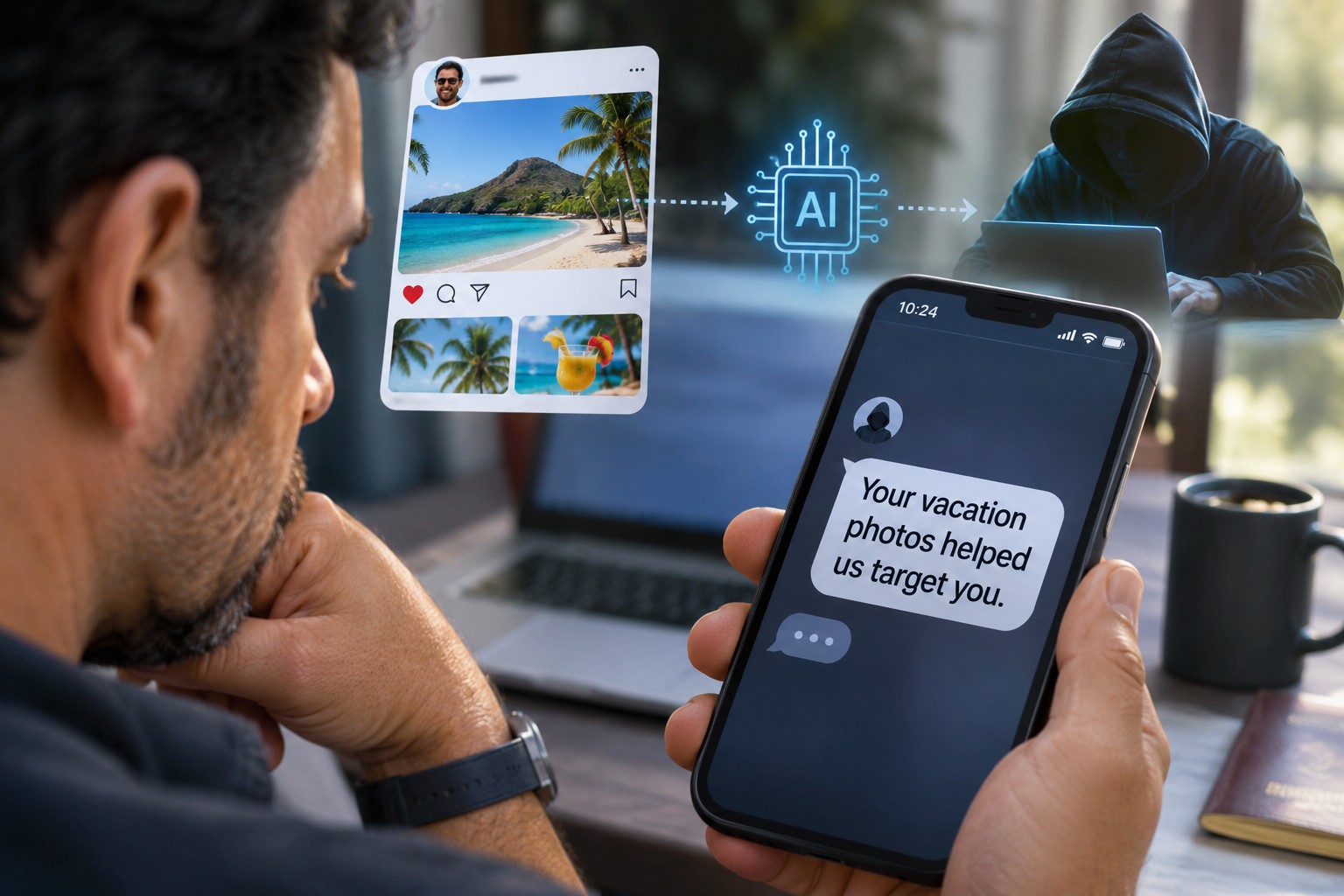
Your vacation photos, family updates, and professional posts can provide scammers with personal details they use to manufacture trust and target you with convincing fraud.
AI-powered scams are becoming more sophisticated as cybercriminals use publicly available social media information to create personalized phishing messages, clone voices, and generate realistic deepfakes. Research from the University of Texas at Arlington highlights how AI can transform personal online activity into targeted fraud. Consumers and small businesses can reduce their exposure by limiting publicly shared information, verifying unexpected requests through trusted channels, enabling multifactor authentication, and implementing stronger payment approval procedures.
AI-powered scams are becoming more sophisticated as cybercriminals use publicly available social media information to create personalized phishing messages, clone voices, and generate realistic deepfakes. Research from the University of Texas at Arlington highlights how AI can transform personal online activity into targeted fraud. Consumers and small businesses can reduce their exposure by limiting publicly shared information, verifying unexpected requests through trusted channels, enabling multifactor authentication, and implementing stronger payment approval procedures.
The days of laughably obvious scam emails filled with spelling mistakes and suspicious promises are fading. Today’s cybercriminals have something far more powerful: artificial intelligence capable of turning your personal information into convincing fraud.
A familiar voice, a realistic video call, or an email mentioning details from your recent vacation might seem trustworthy. But in the age of AI, appearances can be dangerously misleading. And the information helping scammers target you may already be sitting on your social media profiles.
How Your Social Media Posts Become Scam Material
A November 2026 study from the University of Texas at Arlington (UTA) highlighted how artificial intelligence can analyze publicly available social media posts to create highly personalized phishing messages. Researchers examined a technique known as context-aware spear phishing, which uses details about someone’s activities, relationships, and interests to make fraudulent communications appear legitimate.
Imagine posting vacation photos from Miami. Shortly afterward, you receive an email supposedly from your hotel offering a special discount on your next stay. The message mentions the destination, dates, or experiences you shared online. Everything feels familiar, making you more likely to click. That’s precisely what makes AI-powered phishing so dangerous: scammers can use your own digital footprint to manufacture trust.
When AI Can Imitate Your Boss or Family Members
The threat extends beyond suspicious emails.With AI voice cloning and deepfake technology, criminals can imitate voices, generate realistic images, and create convincing video impersonations.
Imagine receiving an urgent phone call from someone who sounds exactly like your daughter, asking for emergency financial assistance. Or picture an employee joining a video meeting with someone who appears to be the company’s attorney, confirming instructions to transfer funds. These scenarios are no longer limited to science fiction.
In November 2026, U.S. authorities announced charges against three individuals in an alleged $129 million fraud scheme involving AI-generated impersonations of executives and legal professionals.
The case illustrates how sophisticated impersonation can threaten businesses, financial institutions, and ordinary consumers alike. Even emotionally sensitive situations are being exploited. Scammers have reportedly used AI-generated photographs to deceive people searching for missing pets, demanding money under false pretenses.
Why Small Businesses Are Especially Vulnerable
For entrepreneurs and small-business owners, the consequences can extend far beyond one fraudulent payment. A criminal might impersonate a CEO requesting a confidential wire transfer, a vendor announcing updated banking details, or a trusted employee asking for access to company accounts.
Smaller organizations may lack dedicated cybersecurity teams or formal verification procedures, making human judgment particularly important.
AI-powered social engineering attacks exploit trust, urgency, and routine business relationships, often without requiring criminals to hack a computer system. And while older adults may be less familiar with certain emerging technologies, younger generations are not immune. Digital confidence doesn’t automatically translate into cybersecurity awareness.
Six Ways to Protect Yourself from AI Scams
Small businesses are particularly exposed to AI-powered fraud when criminals exploit routine business relationships, impersonate executives, or request fraudulent wire transfers and banking changes
1) Question urgent requests. Be cautious when someone pressures you to send money or disclose sensitive information immediately.
2) Verify through another channel. Call a known number rather than trusting the contact information in a suspicious message.
3) Limit public personal details. Review privacy settings and avoid revealing unnecessary information about travel, family, or daily routines.
4) Create a family verification phrase. A private phrase can provide an additional safeguard against impersonation.
5) Use multifactor authentication (MFA). Protect email, banking, and business accounts with stronger sign-in security.
6) Establish payment verification procedures. Businesses should independently confirm changes to banking instructions and high-value transfers.
The New Rule of Digital Trust
Artificial intelligence offers extraordinary opportunities for productivity, communication, and business growth. Unfortunately, those same capabilities can also make deception more convincing.
The solution isn’t to abandon technology or social media. It’s to become more intentional about what we share and how we verify unexpected requests.
A recognizable face, a familiar voice, or a message containing accurate personal details is no longer proof of authenticity. In today’s digital world, a few extra seconds of verification could prevent a costly mistake.
Frequently Asked Questions (FAQ)
1. Can scammers use my social media posts to create AI-powered scams?
Yes. AI tools can analyze publicly available social media information, including travel photos, professional updates, and personal interests, to create personalized phishing messages that appear trustworthy.
2. What is AI-powered spear phishing?
AI-powered spear phishing is a targeted cyberattack that uses artificial intelligence to craft deceptive messages based on information about a specific person or organization. These messages often impersonate trusted contacts or businesses.
3. Can AI clone someone’s voice to commit fraud?
Yes. AI voice-cloning technology can generate convincing imitations of real voices using recorded audio. Criminals may exploit this capability to impersonate family members, executives, or other trusted individuals.
4. How can small businesses protect themselves from AI scams?
Small businesses should establish payment verification procedures, use multifactor authentication, train employees to recognize suspicious requests, and independently confirm changes to vendor banking information.
5. Are deepfake videos easy to detect?
Not always. Modern deepfake technology can produce highly realistic video and audio. Rather than relying exclusively on visual inconsistencies, verify unexpected requests through a separate, trusted communication channel.
6. What should I do if I suspect an AI-powered scam?
Stop communicating with the suspected scammer, avoid sending money or sensitive information, and contact the affected financial institution if necessary. In the United States, suspected fraud can be reported to the Federal Trade Commission or the FBI’s Internet Crime Complaint Center.